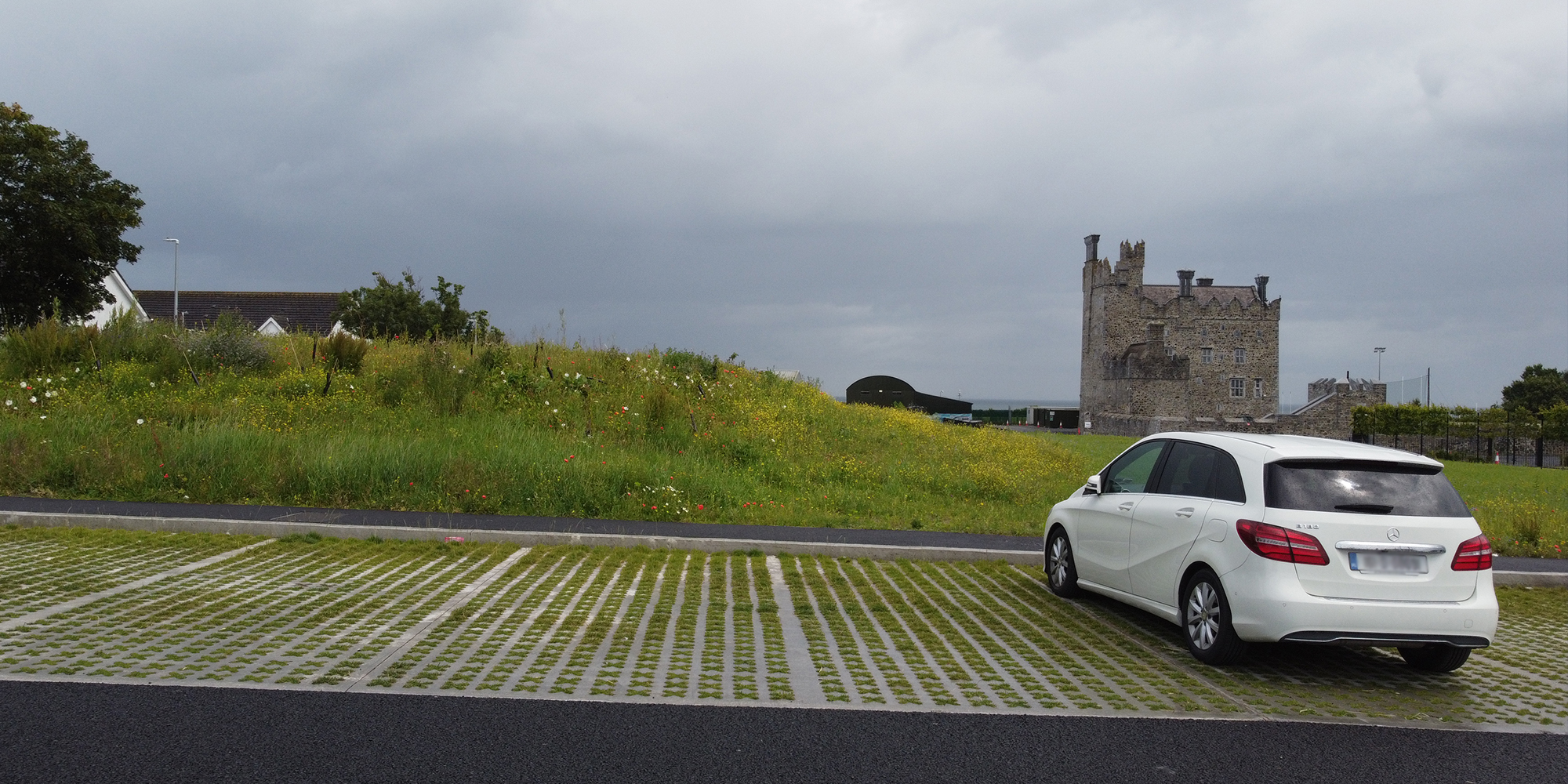
1. Project Overview
The practice was commissioned by the lead contractor DANCOR to develop a series of SuDS-based car parks and overflow car parks for Fingal County Council in Balbriggan. The project’s primary objective was to integrate sustainable drainage principles into the car park design, ensuring that the quantity, rate, and quality of surface water runoff remained consistent with pre-development conditions.
________________________________________
2. Sustainable Drainage Design Approach
The design incorporates a fully permeable surface system across car parks, access roads, courts, and pedestrian paths. These permeable surfaces allow rainwater to infiltrate through the pavement layers, mimicking the natural infiltration processes of field soils.
Key SuDS features include:
• Permeable Surfacing: Designed to temporarily store runoff within the sub-base, slowing the rate of discharge and promoting groundwater recharge.
• Sub-base Filtration: Gravel sub-bases provide natural filtration, treating hydrocarbons and other pollutants that may originate from vehicle use.
• Swales with Check Dams: Any residual runoff from permeable areas is directed into swales, where water is slowed and partially re-infiltrated into the ground.
• Bioretention Basins and Soakaways: During significant storm events, runoff is temporarily stored in these features, which allow gradual infiltration back into the groundwater system at rates similar to the existing semi-natural state.
• Pre-treatment Catchpits (as required): Installed in specific areas, subject to final detailed design, to remove sediment and pollutants prior to infiltration.
________________________________________
3. Outcomes and Performance
The completed car parks successfully demonstrate how sustainable design principles can be applied to meet both functional and environmental objectives.
They provide adequate vehicular capacity while ensuring that drainage, water quality, and ecological performance are maintained or improved.
In summary, the Fingal Car Parks project effectively balances engineering performance, sustainability, and landscape integration, serving as a model of best practice in SuDS implementation for public infrastructure projects.